What's the Difference Between Remy, Virgin & 100% Human Hair?

Unfortunately, finding the right wig can be quite a challenge. A quick search for natural wigs will pull up endless choices that leave you feeling confused, uncertain, and farther from your dream hair. You'll also quickly realize that not all wigs are created equal: there are synthetic wigs, human hair wigs, virgin hair wigs, and Remy hair wigs, but which is right for you?
Remy hair has become increasingly popular among wig wearers seeking quality and longevity. But most people also wonder, “What is Remy hair and how does it differ from all these other options?”
Daniel Alain is a leading expert in hair care solutions and offers expert insight to help us understand the different types of natural wigs.
Over the years, Daniel has witnessed firsthand the power of a good wig on a person's self-esteem and well-being. However, finding the right wig that matches the highest quality standards can be elusive.
“Just because it's human hair doesn't mean it's good quality; it can be floor hair or bad quality. There is no one to police (the wig industry) because it's not FDA regulated,” Daniel said.
Not to worry, because we're breaking it all down for you in this guide! You've heard of Remy hair, virgin hair, and 100% human hair, but are they the same? The short answer is no. To get the long answer (and your best hair ever), keep reading.

Wigs, human hair extensions, and hairpieces are on the rise thanks to trendsetting celebs like Beyoncé, Kim Kardashian, and Hailey Baldwin. Why are they so popular? Because, unlike synthetic wigs and hairpieces, human hair wigs move and bounce naturally with style and grace. If you're curious about why are human-hair wigs more expensive, it comes down to this natural quality and movement.
Still, just because it's human hair doesn't make it good hair. The fact is, there are drastic variances between products. Factors like production, manufacturing processes, hair types, and chemical treatments can turn a natural wig into a messy, tangled nightmare.
In other words, you'll need to conduct your due diligence to vet the market for high-quality options in natural wigs, and we're here to help you do that.
First order of business: What's the difference between Remy hair, virgin hair, and 100% human hair?
UNDERSTANDING HAIR QUALITY IN HUMAN HAIR WIGS
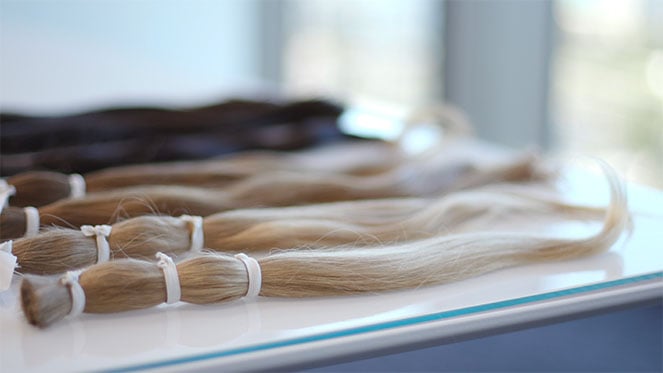
Hair grows through the cuticles from one direction on a scalp, and you'll want that same fluidity from your wig. Quality wigs have an intact cuticle that naturally directs the hair and produces a shiny, natural-looking sheen for a healthier appearance.
Daniel explains it's not always easy to know if a wig has intact cuticles. Another way to spot natural hair?
“When you wash and shampoo the hair, you can tell: if it becomes slimy and silky, the hair has been chemically treated. If the hair feels dry: it's natural hair, it's Remy. For tips on how to revive human hair wig and restore its natural feel, proper care techniques make all the difference."
But what if it's not Remy hair?
How hair is collected can affect the direction of its cuticles. Non-Remy hair refers to human hair that has been collected without ensuring that all the cuticles run in the same direction. When the cuticles are not aligned, the wig is more prone to tangling, matting, and breakage because the hair strands rub against each other in different directions. When the cuticle remains intact, the strands can follow their natural direction instead of creating unnecessary friction.
In human hair wigs or toppers, non-Remy hair can significantly impact the overall quality and durability. Since it tangles easily, wearers might find themselves spending more time detangling and maintaining the piece.
Non-Remy hair also tends to have a shorter lifespan and may not hold styles as well as higher-quality hair, such as Remy or virgin hair. Because of these issues, wigs and toppers made with non-Remy hair may feel less natural and comfortable and often require more frequent replacement, even with proper care. To learn more about the most comfortable wigs, it helps to understand how hair quality plays a role.
This leads us to another snag. The wig industry is entirely unregulated, which means anyone can advertise human hair as Remy hair without proof of quality or origin. And you can't go on prices alone since manufacturers can throw whatever price tag they want on their wigs.
Daniel's advice for dodging the bad to get to the goods?
“You have to check the brands and reviews to see what everyone is saying. Go to a wig shop and try them on. When you try on a high-quality wig, you'll notice a difference right away. It's very hard for a woman to go backward from the highest quality; that's how you get the education."
Before you start shopping, let's get up to speed on the difference between virgin hair, Remy hair, and non-Remy hair. Understanding both Remy and virgin hair will help you identify premium options.
TYPES OF NATURAL HAIR AND KEY DIFFERENCES

Understanding natural hair types is essential when shopping for wigs. Virgin hair, Remy hair, and non-Remy hair are all 100% human hair, but they are far from the same. Both Remy and virgin hair offer superior quality compared to non-Remy options.
-
Virgin hair is 100% human hair that has never been chemically treated or dyed and may come from a single donor.
-
Remy hair is human ponytail hair with the cuticle in one direction, but it can be dyed or treated hair.
-
100% human hair is any hair from a human scalp — meaning it can come from the floor of a hair salon, a brush, or even a corpse.
And now you've fully realized why learning the difference between the three is crucial! But as Daniel explains, treatments aren't the only factor that matters when evaluating hair quality.
What is Virgin Hair
Virgin hair represents the highest standard of unprocessed hair available. Virgin European hair has never been tainted by toxic chemicals or dyes—it remains completely unprocessed. Virgin hair wigs offer unmatched versatility since the hair has never been altered.
However, as Daniel points out, you can't get it anymore. Decades ago, manufacturers sourced virgin hair primarily from China, India, Vietnam, and Russia. During that time, women in the countryside could make a good income by selling their virgin ponytails with the cuticles lying in the same direction, which became known as "Remy" hair.
Now, manufacturers rarely get virgin European hair.
As hair trends and styles evolved, it became more difficult to track down virgin European hair that hadn't been chemically processed. Fortunately, Daniel spent decades perfecting the art of preserving human hair's integrity, amassing a private collection of about 135,000 pounds of premium European virgin hair in different lengths.
“We are the only ones who have a big stock of virgin European natural hair. If you buy one of our Chic or Grandeur wigs, you'll see that it wasn't chemically treated and can last you for years and years and years."
How does non-Remy hair compare? Simply put, it doesn't.
What is Non-Remy Hair
Unlike Remy hair, non-Remy hair is more readily available and typically costs less, even though both are made from human hair.
How do manufacturers get the hair? Unlike FOLLEA's private collection of natural hair, most manufacturers use a mixture of hair from China, Vietnam, and India. To streamline production, the hair undergoes chemical processing in huge acid baths to strip away the cuticles.
“Say you take non-Remy hair off the floor; it'll be all different textures. The way to fix it with a low quality wig is to perm it. Straight hair, curly hair, all that hair has been really processed," Daniel explains.
The result is a "one-size-fits-all" product that often lacks a consistent texture, tangles easily, and can become brittle or dull over time. The problem with this method is that we all have different hair types, textures, and unique qualities that can affect how a wig looks and feels. If you have wavy, fine hair, you deserve a wig made from wavy, fine hair, right? Right.
What is Remy Hair
Contrary to popular belief, Remy and virgin hair are not the same. Remy hair is natural hair that can be either virgin or treated. Remy hair extensions and wigs could come with highlights, lowlights, and color treatment to make them ready to wear. But again, just because it's sold as Remy hair doesn't automatically mean it's of the highest quality.
There are two key components to premium Remy hair: origin and manufacturing processes.
Daniel Alain works with European hair and sorts hair by type (thick, thin, fine, coarse, curly, straight) and cuticle direction. This attention to detail helps make styling Remy hair easier, particularly when matching the hair to a wearer's natural texture.
Most manufacturers soak hair in an acid bath to achieve higher production volumes. Unfortunately, the quality plummets because the cuticles aren't intact, and thus, the direction of the hair isn't consistent. They point in different directions, making them harder to style and manage.
Daniel Alain's process?
“We have (a staff of) 100 people making sure the hair maintains one direction; that is a specialty to ensure the hair stays in the same direction throughout the entire manufacturing process."
The final result? Stunning Remy hair that perfectly matches your natural hair color, type, style, and above all — personality!
“This hairline is flawless. I can't even tell I'm wearing a wig in this picture!!," writes Natalie of @Alopecia_Fashionista.
There's a method to the magic, so are you ready to finally get the wig you deserve?
There's a method to the magic, so are you ready to finally get the wig you deserve?

You're not alone if you've struggled with the endless choice in wigs or feel a bit clueless about the differences between Remy hair, virgin hair, and non-Remy hair. Fortunately, experts like Daniel Alain have dedicated years to perfecting the art of wig-making and offering valuable insight to help consumers like you make informed decisions.
As the offspring of two pioneering parents in the hair and wig industries, Daniel's work isn't just a passion; it's in his blood. His mission? To empower people and make them feel beautiful.
With the information laid out in this guide, you now have the tools to distinguish between premium wigs and lower-quality alternatives to ensure you invest in a piece that enhances your appearance, boosts your confidence, and matches your personality and lifestyle.
Understanding proper maintenance practices, such as using a silk pillowcase and avoiding excessive heat styling, can protect your investment in real human hair. Whether you choose regular virgin hair or Remy hair, understanding the difference between minimally processed and heavily treated extensions will help you make the right choice.
Now that you know all about the difference between Remy hair, virgin hair, and 100% human hair, you should feel better prepared to make the right choice for you.
If you'd like to know more about the premium-quality human hair wigs we make here at Daniel Alain, we encourage you to consider using our expert consultation services. Our consultations are free and private, and can take place in our Newport Beach, CA showroom, or virtually over Zoom from the comfort of your own home.
“You can transform a woman in five seconds. Just put the wig on and see."


 Call Us
 Showroom